

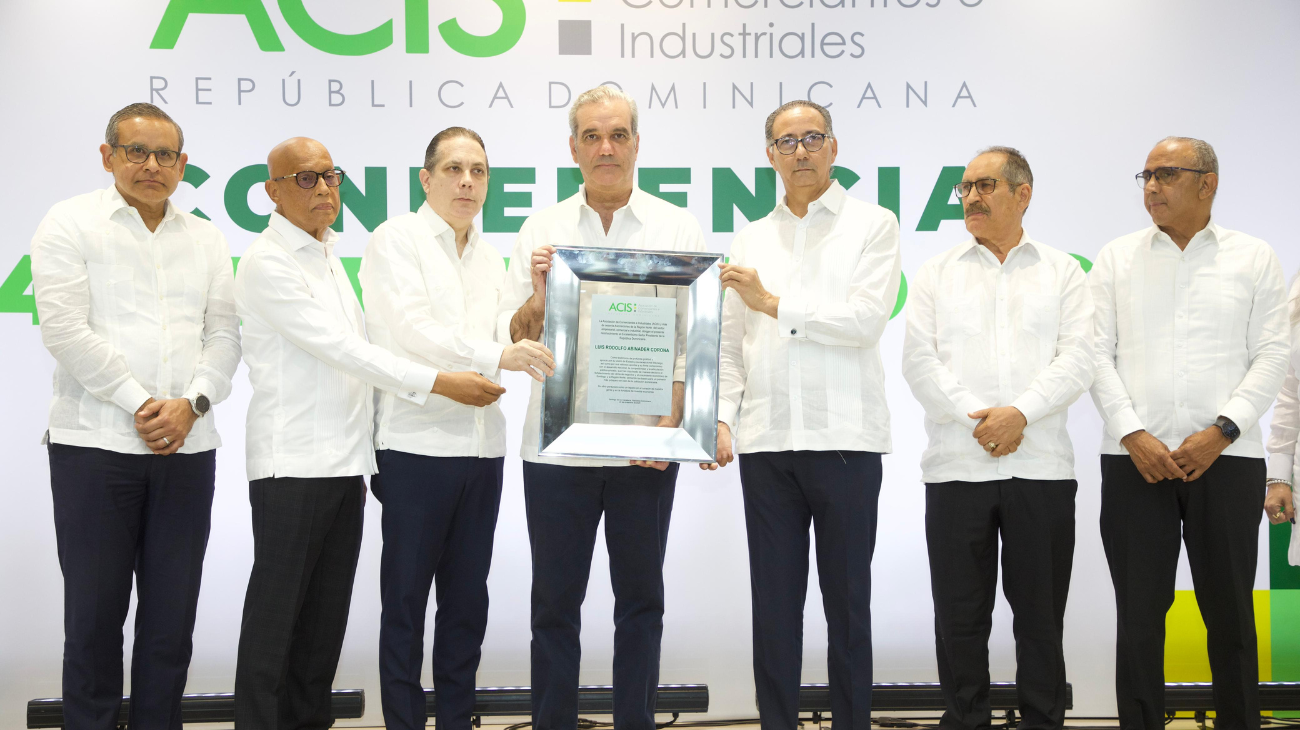
SANTIAGO, Dominican Republic – President Luis Abinader declared Saturday that his administration has transformed the Dominican Republic into a "polycentric republic," nurturing robust development hubs across the Cibao, Southern, and Eastern regions, alongside Greater Santo Domingo. Abinader received a special recognition from the Association of Merchants and Industrialists of Santiago (ACIS) for allocating unprecedented resources to the province's growth.
The award was presented during ACIS's 64th-anniversary celebration. The organization represents 63 business associations and over 3,000 direct members throughout the country's northern region.
Economic Contributions and Key Investments
In his address, President Abinader highlighted Santiago and the Cibao region's significant economic impact, contributing nearly 40% of the national GDP. He noted their leadership in free zone exports and their role in sustaining a substantial portion of the nation's formal employment.
"Every peso invested here multiplies into jobs, entrepreneurship, and competitiveness," Abinader emphasized.
The president announced that the tender for the Santiago–Puerto Plata highway, also known as the Amber Road, was published Thursday. This project, which will operate under a public-private partnership model, has an initial deposit of RD 8 billion to facilitate its immediate commencement.
Four Pillars of Development
Abinader outlined four major development poles he believes are reshaping the country's economic landscape:
- Northern Region (Cibao): Positioned as an industrial and innovation hub, with Santiago serving as its productive capital. Initiatives include expanding and modernizing free zones, the ongoing Santiago Monorail and Cable Car projects, new inter-municipal road connections, and expanding 5G coverage.
- Eastern Region: Designated as a global tourism and services hub. In Miches, a partnership with Promiches has increased projected hotel projects from five to seven currently under construction, creating thousands of direct and indirect jobs in El Seibo province.
- Southern Region: Identified as an emerging 21st-century pole, with Pedernales–Cabo Rojo as a key driver. Abinader cited the new Cabo Rojo pier, which recently hosted two cruise ships simultaneously—a feat he described as "unthinkable five years ago." This development is expected to positively impact Pedernales, Independencia, Bahoruco, and Barahona provinces.
- Greater Santo Domingo: Defined as the country's financial, administrative, and technological center, now complemented by strong, decentralized regions.
The head of state also underscored comprehensive development in Manzanillo, where a new port is under construction, projected to reduce export times to the United States by one hour. The area will also see a 1,600-megawatt power generation plant, representing the largest private energy investment in decades, and a special industrial zone. The old port, Abinader added, will be converted into a tourist and multimodal pier.
Macroeconomic Achievements
Despite global challenges like the pandemic, inflation, and geopolitical tensions, Abinader highlighted that the Dominican Republic has achieved one of Latin America's highest accumulated growth rates over the past five years.
Key indicators mentioned:
- Tourism: Continues to set historical records, with projections to surpass 10 million visitors again in 2025.
- Foreign Direct Investment: Expected to exceed USD 5 billion by year-end.
Abinader asserted that exports have shown sustained growth and increased diversification, while inflation has been controlled without sacrificing economic growth, exchange rate stability, or fiscal soundness.
"Confidence is the most valuable economic asset a nation can have, and we have built that confidence together: Government, private sector, and society," Abinader stated.
ACIS President Marcos Santana, joined by former presidents and representatives from the agricultural, construction, commerce, import, and provisions sectors, presented the recognition plaque to Abinader for "his leadership and historic commitment to the development of Santiago and the Northern region."
"The Dominican Republic will be as strong as Santiago, and Santiago will be as strong as its entrepreneurs," President Abinader concluded, reaffirming his commitment to collaborating with the business sector to consolidate a country of opportunities across all its regions.
Sources
Related News
World Bank Officials Praise Dominican Republic's Economic Stability
3 min read
Dominican Republic Launches $106 Million Fund for Irrigation Upgrade
3 min read
Dominican Republic to Overhaul 496 Schools with RD$2 Billion Investment
3 min read
Dominican Government Settles $104 Million Debt with Small Farmers
3 min read